Alcohol Sensor Based on Gas-Sensitive Resistive Materials: Difference between revisions
Created page with "== Introduction == The MQ-3 is a low-cost metal-oxide semiconductor (MOS) gas sensor designed for the detection of alcohol (ethanol) vapor in air. It is widely used in breathalyzers, vehicle safety systems, and environmental monitoring due to its high sensitivity to ethanol and relatively low sensitivity to interfering gases such as benzene and smoke. The sensing material is tin dioxide (SnO<sub>2</sub>), an n-type metal-oxide semiconductor. Structurally, the sensor co..." |
|||
| (37 intermediate revisions by the same user not shown) | |||
| Line 1: | Line 1: | ||
== Team Members and Contributions == | |||
This project was completed collaboratively by four team members, with responsibilities assigned as follows. | |||
Lyu Jiaxin was responsible for the analysis of sensor characteristics and the web content development. | |||
Yue Yucheng was responsible for the design and implementation of the alcohol detection and alarm system using Arduino. | |||
Zhang Ningxin was responsible for the introduction and the theoretical working principle of the sensor. | |||
Zhong Yihui was responsible for the experimental system setup and data analysis, including the analysis of sensitivity, dynamic response, and distance effects. | |||
All team members jointly participated in the experimental design, experimental procedures, and data acquisition. | |||
== Introduction == | == Introduction == | ||
The MQ-3 is a low-cost metal-oxide semiconductor (MOS) gas sensor designed for the detection of alcohol (ethanol) vapor in air. It is widely used in breathalyzers, vehicle safety systems, and environmental monitoring due to its high sensitivity to ethanol and relatively low sensitivity to interfering gases such as benzene and smoke. | The MQ-3 is a low-cost metal-oxide semiconductor (MOS) gas sensor specifically designed for the detection of alcohol (ethanol) vapor in air. It is widely used in breathalyzers, vehicle safety systems, and environmental monitoring due to its high sensitivity to ethanol and relatively low sensitivity to interfering gases such as benzene and smoke. | ||
The sensing material is tin dioxide (SnO<sub>2</sub>), an n-type metal-oxide semiconductor. Structurally, the sensor consists of a miniature Al<sub>2</sub>O<sub>3</sub> ceramic tube coated with a SnO<sub>2</sub> sensitive layer, gold electrodes | The sensing material is tin dioxide (SnO<sub>2</sub>), an n-type metal-oxide semiconductor. Structurally, the sensor consists of a miniature Al<sub>2</sub>O<sub>3</sub> ceramic tube coated with a SnO<sub>2</sub> sensitive layer, gold electrodes, platinum lead wires, and a Ni–Cr alloy heater coil. These components are enclosed in a protective housing with a stainless-steel mesh. | ||
The built-in heater maintains the sensing layer at an elevated operating temperature of approximately 250–400 °C, which is | The built-in heater maintains the sensing layer at an elevated operating temperature of approximately 250–400 °C, which is essential for activating surface reactions. The sensor operates at a supply voltage of 5 V with a heating power consumption below 750 mW. | ||
In clean air, the SnO<sub>2</sub> surface exhibits high resistance. When exposed to ethanol vapor, surface reactions release electrons back to the conduction band, leading to a decrease in resistance. This resistance change is converted into a measurable voltage signal correlated with ethanol concentration. | |||
== Working Principle == | == Working Principle == | ||
The | The response of SnO<sub>2</sub>-based gas sensors originates from surface reactions between adsorbed oxygen species and reducing gases such as ethanol. This mechanism governs the relationship between gas concentration and electrical resistance. | ||
In ambient air, oxygen molecules adsorb onto the SnO<sub>2</sub> surface and capture electrons from the conduction band, forming negatively charged oxygen species. This | In ambient air, oxygen molecules adsorb onto the SnO<sub>2</sub> surface and capture electrons from the conduction band, forming negatively charged oxygen species. This process creates an electron depletion layer and increases the potential barrier, resulting in high resistance. | ||
When ethanol vapor is introduced, it reacts with the pre-adsorbed oxygen species, releasing electrons back into the conduction band. As a result, the depletion layer narrows, the potential barrier decreases, and the | When ethanol vapor is introduced, it reacts with the pre-adsorbed oxygen species, releasing electrons back into the conduction band. As a result, the depletion layer narrows, the potential barrier decreases, and the resistance drops.[1] | ||
This mechanism explains the empirical observation in the MQ-3 datasheet: increasing ethanol concentration leads to a decrease in sensor resistance (R<sub>s</sub>) | This mechanism explains the empirical observation in the MQ-3 datasheet: increasing ethanol concentration leads to a decrease in sensor resistance (R<sub>s</sub>). | ||
The process can be described in three sequential steps: | The sensing process can be described in three sequential steps: | ||
(1) Oxygen adsorption | |||
O<sub>2</sub>(g) + 2e<sup>-</sup> ⇄ 2O<sup>-</sup>(ads) | O<sub>2</sub>(g) + 2e<sup>-</sup> ⇄ 2O<sup>-</sup>(ads) | ||
Oxygen molecules adsorb on the SnO<sub>2</sub> surface at elevated temperature | Oxygen molecules adsorb on the SnO<sub>2</sub> surface at elevated temperature and capture electrons, forming ionized oxygen species and creating an electron depletion layer. | ||
(2) Ethanol reaction | |||
CH<sub>3</sub>CH<sub>2</sub>OH(g) + 6O<sup>-</sup>(ads) → 2CO<sub>2</sub>(g) + 3H<sub>2</sub>O(g) + 6e<sup>-</sup> | CH<sub>3</sub>CH<sub>2</sub>OH(g) + 6O<sup>-</sup>(ads) → 2CO<sub>2</sub>(g) + 3H<sub>2</sub>O(g) + 6e<sup>-</sup> | ||
Ethanol reacts with the adsorbed oxygen species, producing CO<sub>2</sub> and H<sub>2</sub>O while releasing electrons | Ethanol reacts with the adsorbed oxygen species, producing CO<sub>2</sub> and H<sub>2</sub>O while releasing electrons. | ||
(3) Resistance change | |||
The released electrons increase carrier density and | The released electrons increase carrier density and conductivity, leading to a decrease in sensor resistance (R<sub>s</sub>). The magnitude of this change depends on ethanol concentration. | ||
* electron density ↑ | * electron density ↑ | ||
* conductivity ↑ | * conductivity ↑ | ||
* resistance (R<sub>s</sub>) ↓ | * resistance (R<sub>s</sub>) ↓ | ||
The resistance variation is converted into a voltage signal through a voltage-divider circuit and measured by an analog-to-digital converter (ADC), enabling real-time | The resistance variation is converted into a voltage signal through a voltage-divider circuit and measured by an analog-to-digital converter (ADC), enabling real-time detection. The process is reversible: when ethanol is removed, oxygen re-adsorption restores the initial high-resistance state.[2] | ||
== Sensor Characteristics == | |||
Based on the sensing mechanism described above, the macroscopic performance of the MQ-3 sensor can be characterized by a set of measurable parameters, which reflect different aspects of the underlying surface reaction processes. | |||
=== | === Sensor Resistance (Rs) and Normalized Response (Rs/R0) === | ||
The MQ-3 | The MQ-3 sensor response is characterized by the resistance R<sub>s</sub> under gas exposure and a reference resistance R<sub>0</sub> measured at a standard condition. In practice, the normalized ratio R<sub>s</sub>/R<sub>0</sub> is used (see Appendix A). | ||
Using R<sub>s</sub> alone is not sufficient, as the absolute resistance varies between sensors and is affected by temperature, humidity, and drift. The same ethanol concentration may therefore correspond to different R<sub>s</sub> values. | |||
The ratio R<sub>s</sub>/R<sub>0</sub> normalizes these variations and represents the relative change in resistance caused by surface reactions, making the response comparable and consistent with the datasheet curve. | |||
< | As ethanol concentration increases, R<sub>s</sub> decreases, leading to a lower R<sub>s</sub>/R<sub>0</sub> value. This trend is consistent with experimental observations [3]. | ||
R | |||
</ | |||
Therefore, calibration is required to establish the relationship between R<sub>s</sub>/R<sub>0</sub> and ethanol concentration. | |||
=== Operating Temperature and Preheating === | |||
In practical applications of the MQ-3 alcohol sensor, operating temperature and preheating are critical factors that directly influence measurement stability and accuracy. According to the device datasheet, the MQ-3 sensor incorporates an internal heater, and its sensing material (SnO₂) must operate under elevated temperature conditions to function properly. The datasheet explicitly specifies that a long preheating period (typically over 24 hours) is required to establish a stable thermal equilibrium and baseline resistance (see Appendix A). This indicates that the sensor resistance (Rs) is not an intrinsic constant, but rather a temperature-dependent parameter that evolves until the thermal field stabilizes. Experimental studies further confirm this behavior: even after sufficient preheating, the MQ-3 sensor still exhibits a transient stabilization phase during each measurement cycle, with response values typically reaching steady state within tens of seconds (approximately 13–40 s), depending on sample conditions [4]. | |||
From a mechanistic perspective, this behavior originates from the temperature-dependent surface reaction processes of metal oxide gas sensors. For n-type semiconductors such as SnO₂, the sensing mechanism is governed by redox reactions between adsorbed oxygen species and reducing gases. In ambient air, oxygen molecules are adsorbed onto the sensor surface and capture electrons from the conduction band, forming ionized oxygen species (e.g., O⁻, O₂⁻), which create an electron depletion layer and increase the sensor resistance. Upon exposure to ethanol, these adsorbed oxygen species participate in oxidation reactions, releasing electrons back to the conduction band and thereby decreasing resistance. This process is strongly controlled by temperature, which governs adsorption–desorption equilibrium and reaction kinetics. It has been established that metal oxide gas sensors exhibit a characteristic temperature-dependent response curve, where sensitivity increases with temperature in the low-temperature regime due to enhanced reaction kinetics, reaches a maximum at an optimal operating temperature, and then decreases at higher temperatures due to accelerated desorption [5]. For SnO₂-based ethanol sensors, this optimal operating region is typically around 250–300 °C, where surface reaction rates and oxygen coverage achieve a balance [6]. Additional studies also report that increasing temperature enhances oxygen ionization and reaction kinetics, while excessively high temperatures reduce gas residence time on the surface, resulting in a decline in sensor response [5,6]. | |||
Further analysis shows that temperature also determines the dominant surface oxygen species and their reactivity, thereby influencing the height of the potential barrier at grain boundaries and the width of the depletion layer. As temperature increases, oxygen ionization and surface reaction rates are enhanced; however, excessive temperature reduces the residence time of gas molecules on the surface, weakening the overall sensor response [5]. Consequently, the sensing behavior is not solely governed by gas concentration but by a coupled equilibrium between thermal conditions and surface chemistry. | |||
Therefore, when the sensor temperature has not fully stabilized, the quantity and distribution of adsorbed oxygen species continue to vary, leading to fluctuations in the depletion layer thickness and corresponding changes in carrier concentration. Simultaneously, the reaction rate between ethanol and surface oxygen species also evolves over time. These coupled effects result in a gradual drift of the sensor resistance (Rs), which manifests as a slow change in the measured signal. This mechanism provides a direct explanation for the experimental observation that the measured concentration continues to decrease over time (e.g., from 15% to 13% after 30 minutes), indicating that the sensor has not yet reached a coupled equilibrium of thermal stability and surface chemical reactions, rather than reflecting an actual decrease in ethanol concentration. | |||
=== Sensitivity (Concentration–Response Relationship) === | |||
Sensitivity describes how strongly the MQ-3 sensor responds to changes in ethanol concentration. It is a key parameter used to evaluate the performance of gas sensors. | |||
For the MQ-3 sensor, sensitivity is typically defined using resistance-based ratios, such as | |||
S = R<sub>air</sub>/R<sub>gas</sub> or the normalized form R<sub>s</sub>/R<sub>0</sub>, as provided in the datasheet (see Appendix A). These definitions quantify the relative change in resistance caused by the presence of ethanol. | |||
A higher sensitivity indicates a larger change in output signal for a given change in concentration, which improves the detectability of ethanol, especially at low concentrations. | |||
In practical applications, sensitivity is used as a primary metric to compare sensor performance and to determine the usable detection range. It also directly affects calibration accuracy and measurement resolution. | |||
=== Dynamic Response (Rise Time and Recovery Time) === | |||
The dynamic behavior of the MQ-3 sensor is characterized by its response time and recovery time. These parameters describe how quickly the sensor reacts to changes in ethanol concentration. | |||
The response time (or rise time) is defined as the time required for the sensor signal to reach | |||
a certain percentage (typically 90%) of its final value after exposure to ethanol. | |||
The recovery time (or decay time) is the time required for the sensor to return to its baseline | |||
value after the ethanol source is removed. | |||
These parameters are important for evaluating the real-time performance of the sensor. A shorter response time allows faster detection, while a shorter recovery time enables repeated measurements with minimal delay. | |||
In practical measurements, both response and recovery times are influenced by gas diffusion and desorption processes, and therefore depend on environmental conditions and measurement setup. | |||
=== Environmental Influence (Humidity and Measurement Conditions) === | |||
The response of the MQ-3 sensor is influenced by external environmental conditions during operation. In addition to ethanol concentration, factors such as humidity, airflow, and spatial distribution of the gas can affect the measured signal. | |||
Humidity is one of the primary environmental factors. Changes in ambient humidity can alter the baseline resistance and modify the sensor response, leading to deviations under identical ethanol concentrations. | |||
In non-controlled environments, the distribution of ethanol vapor is not uniform. The concentration detected by the sensor depends on its position relative to the source and on air movement, which introduces additional variability in the measurement. | |||
Therefore, environmental conditions must be considered when interpreting sensor output. Maintaining consistent measurement conditions is necessary to ensure comparability and reliability. | |||
== Experimental System and Data Acquisition System == | |||
=== Experimental System Design === | |||
The experimental system was constructed using an Arduino Uno development board, an MQ-3 alcohol sensor module, an LCD1602 display with an I2C interface, a red LED indicator, and a 5 V buzzer. The MQ-3 sensor functioned as the sensing element, while the Arduino Uno performed signal acquisition and control. The LCD provided real-time display of sensor readings, and the LED together with the buzzer served as alarm outputs. The overall configuration of the experimental setup and the assembled prototype is presented in Figure 1. | |||
[[File:Figure1.jpg|thumb|center|500px|Figure 1. Experimental setup and assembled hardware: (a) closed-chamber setup with laptop monitoring; (b) assembled hardware prototype.]] | |||
To create a controllable test environment, the whole sensing system was placed inside a transparent plastic chamber during the measurements. Alcohol wipes were used as the ethanol source, and the source-to-sensor distance was adjusted to 0 cm, 5 cm, 10 cm, and 15 cm in separate tests. A laptop was connected to the Arduino through USB, and the Arduino Serial Plotter was used to observe the sensor output in real time. This configuration allowed the system response to be visualized continuously and made it possible to compare the signal evolution under different distance conditions. | |||
Before each measurement, the sensor was powered on and allowed to warm up until the displayed baseline became relatively stable. In our experiments, the stabilized initial value was typically in the range of about 15 to 20. This procedure is necessary for MQ-3 operation because the sensing layer requires heating before stable output can be achieved. | |||
According to the implemented circuit and program, the MQ-3 analog output was connected to pin A0, while the LCD communicated with the Arduino through the SDA and SCL lines. The alarm logic was implemented through digital output control, so that the system could provide both visual and audible warnings during alcohol exposure. The circuit schematic of the complete prototype is shown in Figure 2. | |||
[[File:Figure2.png|thumb|center|500px|Figure 2. Circuit schematic of the prototype system, including the Arduino UNO, MQ-3 sensor, LCD1602 display, LED indicator, and buzzer.]] | |||
The data acquisition method was designed for practical warning and trend observation rather than exact concentration metrology. The Arduino read the analog signal from pin A0, converted it through the Uno's 10-bit ADC, scaled the value by dividing by 10, and displayed it on the LCD as a percentage-like reading. The same value was also sent to the Serial Plotter once every second. A threshold of 30 was used in the control program: when the displayed value exceeded this threshold, the LED and buzzer were activated. Therefore, in this project the displayed number should be interpreted as a relative output used for over-limit judgment and response comparison, rather than as a calibrated ethanol concentration in physical units. | |||
=== Alcohol Detection and Alarm System Using Arduino === | |||
==== System Overview ==== | |||
The system is designed to detect alcohol concentration in the surrounding air and provide both visual and audible warnings. It consists of several functional modules, each with a specific role. | |||
The MQ-3 alcohol sensor is used as the sensing element. It detects alcohol vapor and outputs an analog voltage that varies depending on the concentration. | |||
The Arduino Uno acts as the central controller. It reads the analog signal from the sensor, processes the data, and makes decisions based on a predefined threshold. | |||
The LCD1602 display with I2C interface is used to present the measured value in real time. Compared to simpler indicators, the LCD provides a more flexible and readable output. | |||
A red LED serves as a visual indicator. It is turned on when the detected alcohol level exceeds the safe limit. | |||
A buzzer is used as an audible alarm. In this design, a transistor is included to drive the buzzer, ensuring that sufficient current can be supplied. | |||
All modules are powered by the Arduino and share a common ground, forming a simple but complete sensing and alarm system. | |||
==== Working Principle ==== | |||
The MQ-3 sensor operates based on changes in its internal resistance when exposed to alcohol vapor. As the alcohol concentration increases, the resistance of the sensing material decreases, resulting in a change in the output voltage. | |||
This voltage is read by the Arduino through its analog-to-digital converter (ADC). | |||
The ADC converts the analog signal into a digital value ranging from 0 to 1023. | |||
In this project, the raw sensor value is scaled by dividing by 10 to obtain a simplified percentage-like value. Although this does not represent the exact alcohol concentration, it provides a convenient way to observe changes. | |||
The system continuously monitors this value and compares it with a predefined threshold. When the measured value exceeds the threshold, the system enters an alarm state. | |||
In the alarm state, the LED is turned on to provide a visual warning, and the buzzer is activated to produce an audible signal. When the value falls below the threshold, the system returns to the normal state. | |||
==== Hardware Implementation ==== | |||
The MQ-3 sensor module is connected to the analog input pin (A0) of the Arduino. The module is powered by the 5V supply and shares a common ground. | |||
The LCD1602 display uses I2C communication, which requires only two signal lines: SDA and SCL. This simplifies wiring and reduces the number of pins used on the Arduino. | |||
The LED is connected to a digital output pin through a current limiting resistor to prevent excessive current. | |||
The buzzer is controlled through a transistor. The Arduino provides a control signal to the transistor base, allowing the buzzer to be driven safely with sufficient current. | |||
==== Software Design ==== | |||
The program is implemented using the Arduino IDE. Its main function is to read sensor data, display the result, and control the alarm outputs. | |||
The analog signal from the MQ-3 sensor is read using the analogRead() function. The value is then scaled and displayed on the LCD. | |||
At the same time, the system compares the value with a threshold (set to 30 in this project). Based on this comparison, the LED and buzzer are controlled. | |||
A simplified version of the main logic is shown below: | |||
int value = analogRead(A0) / 10; | |||
lcd.setCursor(0, 0); lcd.print("alcohol:"); lcd.print(value); lcd.print("%"); | |||
if (value > 30) { digitalWrite(2, HIGH); // LED ON digitalWrite(3, LOW); // Buzzer state | |||
} else { digitalWrite(2, LOW); // LED OFF digitalWrite(3, HIGH); // Buzzer state | |||
} | |||
The system updates once every second, allowing continuous monitoring of alcohol levels. | |||
== Results == | |||
=== Sensitivity and Concentration–Response === | |||
The experimental results show that the MQ-3-based system had a clear and repeatable response to alcohol vapor. After warm-up, the baseline output usually remained around 15–20 in clean air. A representative stabilized baseline is shown in Figure 3. Once the alcohol wipe was introduced, the displayed value in many trials increased rapidly to the range of approximately 40–60, indicating a strong response to the presence of ethanol vapor. This behavior is consistent with the working mechanism of the MQ-3 sensor, in which alcohol exposure increases the conductivity of the sensing layer and produces a larger output signal. | |||
[[File:Figure3.png|thumb|center|500px|Figure 3. Representative baseline signal after sensor warm-up, showing a relatively stable initial reading in the range of about 15–20 before alcohol exposure]] | |||
Although the displayed value was written in a percentage-like format, it should not be interpreted as the exact alcohol concentration. In this system, the signal shown on the LCD was a scaled ADC reading used to visualize relative changes and to trigger an alarm when the threshold was exceeded. This design is appropriate for a warning-oriented device, whose main purpose is to determine whether alcohol exposure has risen above a practical limit rather than to perform rigorous quantitative concentration measurement. | |||
From the perspective of concentration–response behavior, the screenshots support a clear qualitative conclusion: higher local alcohol exposure produced higher sensor output. Even without converting the readings into calibrated ppm values, the experiments clearly demonstrate that the system was sufficiently sensitive to distinguish between background air and alcohol-rich conditions. Therefore, for the intended application of alcohol over-threshold warning, the sensor showed adequate practical sensitivity. | |||
=== Dynamic Response Analysis === | |||
The Serial Plotter screenshots show that the system responded quickly after alcohol exposure. In the representative curves, the signal typically remained near the baseline for a period of time and then rose sharply once ethanol vapor reached the sensor. Figure 4(a) shows a typical rapid response at short distance, whereas Figure 4(b) shows the subsequent gradual decay. In several cases, the displayed value increased from around 15–20 to above 45 within only a short sequence of plotted points, indicating a fast practical response. | |||
[[File:Figure4.png|thumb|center|500px|Figure 4. Representative dynamic behavior at 0 cm: (a) rapid signal rise after alcohol exposure; (b) gradual recovery after the response peak.]] | |||
The recovery process was generally slower than the rising process. After the peak value was reached, the signal tended to decay more gradually, often with an extended tail instead of an immediate return to baseline. This is physically reasonable for a metal-oxide gas sensor because recovery depends on ethanol removal, desorption, and re-establishment of the surface equilibrium on the sensing layer. | |||
Another dynamic feature visible in the plots is the presence of fluctuations and occasional secondary peaks after the initial response. These features suggest that the alcohol vapor inside the chamber was not perfectly uniform. Instead, the signal was likely affected by transient vapor transport, local mixing, and residual alcohol remaining in the chamber after the wipe had been introduced or moved. Overall, the dynamic measurements indicate that the system is suitable for real-time alarm applications, where practical threshold detection is more important than highly precise dynamic fitting. | |||
This | === Effect of Distance in a Closed Environment === | ||
The influence of distance was investigated by placing the alcohol wipe at 0 cm, 5 cm, 10 cm, and 15 cm from the sensing device inside the closed chamber. Representative response curves are compared in Figure 5. The screenshots show that the sensor produced clear responses at all four tested distances. This means that, within the enclosed experimental volume, ethanol vapor could still diffuse to the MQ-3 sensor and be detected effectively even when the source was not placed immediately adjacent to it. From a practical viewpoint, this is an encouraging result because it demonstrates that the alarm system remained functional across the whole tested range. | |||
[[File:Figure5.png|thumb|center|500px|Figure 5. Representative sensor output curves obtained at different alcohol-source distances in the closed chamber: (a) 0 cm, (b) 5 cm, (c) 10 cm, and (d) 15 cm.]] | |||
However, the effect of distance did not appear as a strictly monotonic decrease in peak value. In some trials, the 10 cm or 15 cm curves still reached relatively high displayed values. Therefore, the most reliable conclusion is not that the peak output simply decreased linearly with distance, but rather that distance influenced the response profile, including the onset of the signal, the steepness of the rise, and the stability of the curve. In general, the 0 cm and 5 cm measurements showed faster and more direct responses, while the 10 cm and 15 cm measurements more often showed delayed rises, broader peaks, or stronger fluctuations. | |||
This | This behavior can be explained by the closed measurement environment. Inside a confined chamber, ethanol vapor does not travel only along a direct line from source to sensor. Instead, it diffuses, accumulates, and redistributes throughout the chamber volume. As a result, distance still matters, but its effect is coupled with vapor mixing and temporary accumulation. In our setup, distance should therefore be understood as one important factor among several transport-related influences, rather than the sole determinant of signal amplitude. | ||
From these observations, two practical conclusions can be drawn. First, placing the alcohol source closer to the sensor generally leads to a faster and more typical alarm response. Second, because the chamber allows vapor accumulation, the system is still able to detect alcohol reliably even at 15 cm. This means the prototype has useful alarm capability within a finite enclosed space, but it also means that comparative measurements should keep the chamber geometry, source position, and test conditions as consistent as possible if better reproducibility is desired. | |||
== | == Error Analysis == | ||
The uncertainty in this experiment originates from both the intrinsic properties of the MQ-3 sensor and the measurement setup, and it directly affects data consistency and interpretation. | |||
The first source of error is baseline drift of the sensor. The MQ-3 is a metal-oxide semiconductor device whose resistance depends on temperature and surface adsorption equilibrium. During operation, incomplete thermal stabilization and the gradual evolution of adsorbed oxygen species lead to a slow change in Rs. This was reflected in the experiment as a gradual decrease in the displayed value over time. As a result, the baseline cannot be treated as a fixed reference, which introduces systematic deviation in repeated measurements. | |||
The second source of uncertainty is the gas distribution inside the chamber. The experiment was carried out in a closed but uncontrolled environment, where ethanol transport is governed by diffusion and natural convection. This leads to a non-uniform and time-dependent concentration field. The observed signal fluctuations and secondary peaks are consistent with this transport mechanism. Consequently, even under nominally identical conditions, the sensor response may vary due to local concentration differences. | |||
Finally, the data acquisition method introduces additional constraints. The Arduino Uno provides a 10-bit ADC, and the signal is further reduced by scaling. This limits the effective resolution and reduces sensitivity to small signal variations. In addition, the sampling interval of approximately 1 s restricts the ability to resolve rapid transient processes, particularly during the initial response stage. | |||
Taken together, the measurements capture reproducible trends in sensor behavior, but they do not provide high-precision quantitative results. The conclusions should therefore be interpreted within a qualitative or semi-quantitative framework. | |||
== Limitations and Future Improvements == | |||
The current system demonstrates alcohol detection and basic response behavior, but its performance is limited by the lack of calibration, uncontrolled measurement conditions, and restricted data resolution. The sensor output is expressed as a scaled ADC value rather than a calibrated ethanol concentration, which prevents quantitative interpretation of the results. In addition, the use of a simple closed chamber leads to diffusion-dominated and non-uniform vapor distribution, reducing repeatability across measurements. The data acquisition system, including limited ADC resolution and simplified processing, further constrains the precision of dynamic analysis. Future improvements should focus on introducing calibration, improving environmental control, and enhancing data acquisition and analysis methods to achieve more reliable and interpretable measurements. | |||
== References == | |||
[1] Hanwei Electronics Co., Ltd. (n.d.). Technical Data MQ-3 Gas Sensor. Retrieved from https://cdn.sparkfun.com/assets/6/a/1/7/b/MQ-3.pdf | |||
[2] Park, W., et al. (2025). Ultra-sensitive ethanol detection using a chemiresistive RuO₂-functionalized SnO₂ sensor. Microsystems & Nanoengineering, 11, 208. https://doi.org/10.1038/s41378-025-01055-6 | |||
[3] Satria, A. V., & Wildian. (2013). Rancang bangun alat ukur kadar alkohol pada cairan menggunakan sensor MQ-3 berbasis mikrokontroler AT89S51. Jurnal Fisika Unand, 2(1), 13–19. | |||
[4] Cavalcante, J. A., Silva, A. H. M., Gadotti, G. I., de Araújo, Á. S., & Monteiro, R. C. M. (2023). Stabilization of an MQ-3 sensor for ethanol measurement in cowpea seeds. Engenharia Agrícola, 43(2), e20200046. https://doi.org/10.1590/1809-4430-Eng.Agric.v43n2e20200046/2023 | |||
[5] Wang, C., Yin, L., Zhang, L., Xiang, D., & Gao, R. (2010). Metal oxide gas sensors: Sensitivity and influencing factors. Sensors, 10(3), 2088–2106. https://doi.org/10.3390/s100302088 | |||
[6] Dey, A. (2018). Semiconductor metal oxide gas sensors: A review. Materials Science and Engineering: B, 229, 206–217. https://doi.org/10.1016/j.mseb.2017.12.036 | |||
== Appendix A. MQ-3 Sensor Datasheet == | |||
The complete technical datasheet of the MQ-3 gas sensor is provided below for reference. | |||
* [[File:MQ-3.pdf|Download MQ-3 Datasheet]] | |||
Source: Hanwei Electronics Co., Ltd., "MQ-3 Gas Sensor Technical Data", available at: http://www.hwsensor.com | |||
Latest revision as of 11:44, 22 April 2026
Team Members and Contributions[edit | edit source]
This project was completed collaboratively by four team members, with responsibilities assigned as follows.
Lyu Jiaxin was responsible for the analysis of sensor characteristics and the web content development.
Yue Yucheng was responsible for the design and implementation of the alcohol detection and alarm system using Arduino.
Zhang Ningxin was responsible for the introduction and the theoretical working principle of the sensor.
Zhong Yihui was responsible for the experimental system setup and data analysis, including the analysis of sensitivity, dynamic response, and distance effects.
All team members jointly participated in the experimental design, experimental procedures, and data acquisition.
Introduction[edit | edit source]
The MQ-3 is a low-cost metal-oxide semiconductor (MOS) gas sensor specifically designed for the detection of alcohol (ethanol) vapor in air. It is widely used in breathalyzers, vehicle safety systems, and environmental monitoring due to its high sensitivity to ethanol and relatively low sensitivity to interfering gases such as benzene and smoke.
The sensing material is tin dioxide (SnO2), an n-type metal-oxide semiconductor. Structurally, the sensor consists of a miniature Al2O3 ceramic tube coated with a SnO2 sensitive layer, gold electrodes, platinum lead wires, and a Ni–Cr alloy heater coil. These components are enclosed in a protective housing with a stainless-steel mesh.
The built-in heater maintains the sensing layer at an elevated operating temperature of approximately 250–400 °C, which is essential for activating surface reactions. The sensor operates at a supply voltage of 5 V with a heating power consumption below 750 mW.
In clean air, the SnO2 surface exhibits high resistance. When exposed to ethanol vapor, surface reactions release electrons back to the conduction band, leading to a decrease in resistance. This resistance change is converted into a measurable voltage signal correlated with ethanol concentration.
Working Principle[edit | edit source]
The response of SnO2-based gas sensors originates from surface reactions between adsorbed oxygen species and reducing gases such as ethanol. This mechanism governs the relationship between gas concentration and electrical resistance.
In ambient air, oxygen molecules adsorb onto the SnO2 surface and capture electrons from the conduction band, forming negatively charged oxygen species. This process creates an electron depletion layer and increases the potential barrier, resulting in high resistance.
When ethanol vapor is introduced, it reacts with the pre-adsorbed oxygen species, releasing electrons back into the conduction band. As a result, the depletion layer narrows, the potential barrier decreases, and the resistance drops.[1]
This mechanism explains the empirical observation in the MQ-3 datasheet: increasing ethanol concentration leads to a decrease in sensor resistance (Rs).
The sensing process can be described in three sequential steps:
(1) Oxygen adsorption
O2(g) + 2e- ⇄ 2O-(ads)
Oxygen molecules adsorb on the SnO2 surface at elevated temperature and capture electrons, forming ionized oxygen species and creating an electron depletion layer.
(2) Ethanol reaction
CH3CH2OH(g) + 6O-(ads) → 2CO2(g) + 3H2O(g) + 6e-
Ethanol reacts with the adsorbed oxygen species, producing CO2 and H2O while releasing electrons.
(3) Resistance change
The released electrons increase carrier density and conductivity, leading to a decrease in sensor resistance (Rs). The magnitude of this change depends on ethanol concentration.
- electron density ↑
- conductivity ↑
- resistance (Rs) ↓
The resistance variation is converted into a voltage signal through a voltage-divider circuit and measured by an analog-to-digital converter (ADC), enabling real-time detection. The process is reversible: when ethanol is removed, oxygen re-adsorption restores the initial high-resistance state.[2]
Sensor Characteristics[edit | edit source]
Based on the sensing mechanism described above, the macroscopic performance of the MQ-3 sensor can be characterized by a set of measurable parameters, which reflect different aspects of the underlying surface reaction processes.
Sensor Resistance (Rs) and Normalized Response (Rs/R0)[edit | edit source]
The MQ-3 sensor response is characterized by the resistance Rs under gas exposure and a reference resistance R0 measured at a standard condition. In practice, the normalized ratio Rs/R0 is used (see Appendix A).
Using Rs alone is not sufficient, as the absolute resistance varies between sensors and is affected by temperature, humidity, and drift. The same ethanol concentration may therefore correspond to different Rs values.
The ratio Rs/R0 normalizes these variations and represents the relative change in resistance caused by surface reactions, making the response comparable and consistent with the datasheet curve.
As ethanol concentration increases, Rs decreases, leading to a lower Rs/R0 value. This trend is consistent with experimental observations [3].
Therefore, calibration is required to establish the relationship between Rs/R0 and ethanol concentration.
Operating Temperature and Preheating[edit | edit source]
In practical applications of the MQ-3 alcohol sensor, operating temperature and preheating are critical factors that directly influence measurement stability and accuracy. According to the device datasheet, the MQ-3 sensor incorporates an internal heater, and its sensing material (SnO₂) must operate under elevated temperature conditions to function properly. The datasheet explicitly specifies that a long preheating period (typically over 24 hours) is required to establish a stable thermal equilibrium and baseline resistance (see Appendix A). This indicates that the sensor resistance (Rs) is not an intrinsic constant, but rather a temperature-dependent parameter that evolves until the thermal field stabilizes. Experimental studies further confirm this behavior: even after sufficient preheating, the MQ-3 sensor still exhibits a transient stabilization phase during each measurement cycle, with response values typically reaching steady state within tens of seconds (approximately 13–40 s), depending on sample conditions [4].
From a mechanistic perspective, this behavior originates from the temperature-dependent surface reaction processes of metal oxide gas sensors. For n-type semiconductors such as SnO₂, the sensing mechanism is governed by redox reactions between adsorbed oxygen species and reducing gases. In ambient air, oxygen molecules are adsorbed onto the sensor surface and capture electrons from the conduction band, forming ionized oxygen species (e.g., O⁻, O₂⁻), which create an electron depletion layer and increase the sensor resistance. Upon exposure to ethanol, these adsorbed oxygen species participate in oxidation reactions, releasing electrons back to the conduction band and thereby decreasing resistance. This process is strongly controlled by temperature, which governs adsorption–desorption equilibrium and reaction kinetics. It has been established that metal oxide gas sensors exhibit a characteristic temperature-dependent response curve, where sensitivity increases with temperature in the low-temperature regime due to enhanced reaction kinetics, reaches a maximum at an optimal operating temperature, and then decreases at higher temperatures due to accelerated desorption [5]. For SnO₂-based ethanol sensors, this optimal operating region is typically around 250–300 °C, where surface reaction rates and oxygen coverage achieve a balance [6]. Additional studies also report that increasing temperature enhances oxygen ionization and reaction kinetics, while excessively high temperatures reduce gas residence time on the surface, resulting in a decline in sensor response [5,6].
Further analysis shows that temperature also determines the dominant surface oxygen species and their reactivity, thereby influencing the height of the potential barrier at grain boundaries and the width of the depletion layer. As temperature increases, oxygen ionization and surface reaction rates are enhanced; however, excessive temperature reduces the residence time of gas molecules on the surface, weakening the overall sensor response [5]. Consequently, the sensing behavior is not solely governed by gas concentration but by a coupled equilibrium between thermal conditions and surface chemistry.
Therefore, when the sensor temperature has not fully stabilized, the quantity and distribution of adsorbed oxygen species continue to vary, leading to fluctuations in the depletion layer thickness and corresponding changes in carrier concentration. Simultaneously, the reaction rate between ethanol and surface oxygen species also evolves over time. These coupled effects result in a gradual drift of the sensor resistance (Rs), which manifests as a slow change in the measured signal. This mechanism provides a direct explanation for the experimental observation that the measured concentration continues to decrease over time (e.g., from 15% to 13% after 30 minutes), indicating that the sensor has not yet reached a coupled equilibrium of thermal stability and surface chemical reactions, rather than reflecting an actual decrease in ethanol concentration.
Sensitivity (Concentration–Response Relationship)[edit | edit source]
Sensitivity describes how strongly the MQ-3 sensor responds to changes in ethanol concentration. It is a key parameter used to evaluate the performance of gas sensors.
For the MQ-3 sensor, sensitivity is typically defined using resistance-based ratios, such as S = Rair/Rgas or the normalized form Rs/R0, as provided in the datasheet (see Appendix A). These definitions quantify the relative change in resistance caused by the presence of ethanol.
A higher sensitivity indicates a larger change in output signal for a given change in concentration, which improves the detectability of ethanol, especially at low concentrations.
In practical applications, sensitivity is used as a primary metric to compare sensor performance and to determine the usable detection range. It also directly affects calibration accuracy and measurement resolution.
Dynamic Response (Rise Time and Recovery Time)[edit | edit source]
The dynamic behavior of the MQ-3 sensor is characterized by its response time and recovery time. These parameters describe how quickly the sensor reacts to changes in ethanol concentration.
The response time (or rise time) is defined as the time required for the sensor signal to reach a certain percentage (typically 90%) of its final value after exposure to ethanol.
The recovery time (or decay time) is the time required for the sensor to return to its baseline value after the ethanol source is removed.
These parameters are important for evaluating the real-time performance of the sensor. A shorter response time allows faster detection, while a shorter recovery time enables repeated measurements with minimal delay.
In practical measurements, both response and recovery times are influenced by gas diffusion and desorption processes, and therefore depend on environmental conditions and measurement setup.
Environmental Influence (Humidity and Measurement Conditions)[edit | edit source]
The response of the MQ-3 sensor is influenced by external environmental conditions during operation. In addition to ethanol concentration, factors such as humidity, airflow, and spatial distribution of the gas can affect the measured signal.
Humidity is one of the primary environmental factors. Changes in ambient humidity can alter the baseline resistance and modify the sensor response, leading to deviations under identical ethanol concentrations.
In non-controlled environments, the distribution of ethanol vapor is not uniform. The concentration detected by the sensor depends on its position relative to the source and on air movement, which introduces additional variability in the measurement.
Therefore, environmental conditions must be considered when interpreting sensor output. Maintaining consistent measurement conditions is necessary to ensure comparability and reliability.
Experimental System and Data Acquisition System[edit | edit source]
Experimental System Design[edit | edit source]
The experimental system was constructed using an Arduino Uno development board, an MQ-3 alcohol sensor module, an LCD1602 display with an I2C interface, a red LED indicator, and a 5 V buzzer. The MQ-3 sensor functioned as the sensing element, while the Arduino Uno performed signal acquisition and control. The LCD provided real-time display of sensor readings, and the LED together with the buzzer served as alarm outputs. The overall configuration of the experimental setup and the assembled prototype is presented in Figure 1.

To create a controllable test environment, the whole sensing system was placed inside a transparent plastic chamber during the measurements. Alcohol wipes were used as the ethanol source, and the source-to-sensor distance was adjusted to 0 cm, 5 cm, 10 cm, and 15 cm in separate tests. A laptop was connected to the Arduino through USB, and the Arduino Serial Plotter was used to observe the sensor output in real time. This configuration allowed the system response to be visualized continuously and made it possible to compare the signal evolution under different distance conditions.
Before each measurement, the sensor was powered on and allowed to warm up until the displayed baseline became relatively stable. In our experiments, the stabilized initial value was typically in the range of about 15 to 20. This procedure is necessary for MQ-3 operation because the sensing layer requires heating before stable output can be achieved.
According to the implemented circuit and program, the MQ-3 analog output was connected to pin A0, while the LCD communicated with the Arduino through the SDA and SCL lines. The alarm logic was implemented through digital output control, so that the system could provide both visual and audible warnings during alcohol exposure. The circuit schematic of the complete prototype is shown in Figure 2.

The data acquisition method was designed for practical warning and trend observation rather than exact concentration metrology. The Arduino read the analog signal from pin A0, converted it through the Uno's 10-bit ADC, scaled the value by dividing by 10, and displayed it on the LCD as a percentage-like reading. The same value was also sent to the Serial Plotter once every second. A threshold of 30 was used in the control program: when the displayed value exceeded this threshold, the LED and buzzer were activated. Therefore, in this project the displayed number should be interpreted as a relative output used for over-limit judgment and response comparison, rather than as a calibrated ethanol concentration in physical units.
Alcohol Detection and Alarm System Using Arduino[edit | edit source]
System Overview[edit | edit source]
The system is designed to detect alcohol concentration in the surrounding air and provide both visual and audible warnings. It consists of several functional modules, each with a specific role. The MQ-3 alcohol sensor is used as the sensing element. It detects alcohol vapor and outputs an analog voltage that varies depending on the concentration. The Arduino Uno acts as the central controller. It reads the analog signal from the sensor, processes the data, and makes decisions based on a predefined threshold. The LCD1602 display with I2C interface is used to present the measured value in real time. Compared to simpler indicators, the LCD provides a more flexible and readable output. A red LED serves as a visual indicator. It is turned on when the detected alcohol level exceeds the safe limit. A buzzer is used as an audible alarm. In this design, a transistor is included to drive the buzzer, ensuring that sufficient current can be supplied. All modules are powered by the Arduino and share a common ground, forming a simple but complete sensing and alarm system.
Working Principle[edit | edit source]
The MQ-3 sensor operates based on changes in its internal resistance when exposed to alcohol vapor. As the alcohol concentration increases, the resistance of the sensing material decreases, resulting in a change in the output voltage. This voltage is read by the Arduino through its analog-to-digital converter (ADC). The ADC converts the analog signal into a digital value ranging from 0 to 1023. In this project, the raw sensor value is scaled by dividing by 10 to obtain a simplified percentage-like value. Although this does not represent the exact alcohol concentration, it provides a convenient way to observe changes. The system continuously monitors this value and compares it with a predefined threshold. When the measured value exceeds the threshold, the system enters an alarm state. In the alarm state, the LED is turned on to provide a visual warning, and the buzzer is activated to produce an audible signal. When the value falls below the threshold, the system returns to the normal state.
Hardware Implementation[edit | edit source]
The MQ-3 sensor module is connected to the analog input pin (A0) of the Arduino. The module is powered by the 5V supply and shares a common ground. The LCD1602 display uses I2C communication, which requires only two signal lines: SDA and SCL. This simplifies wiring and reduces the number of pins used on the Arduino. The LED is connected to a digital output pin through a current limiting resistor to prevent excessive current. The buzzer is controlled through a transistor. The Arduino provides a control signal to the transistor base, allowing the buzzer to be driven safely with sufficient current.
Software Design[edit | edit source]
The program is implemented using the Arduino IDE. Its main function is to read sensor data, display the result, and control the alarm outputs. The analog signal from the MQ-3 sensor is read using the analogRead() function. The value is then scaled and displayed on the LCD. At the same time, the system compares the value with a threshold (set to 30 in this project). Based on this comparison, the LED and buzzer are controlled. A simplified version of the main logic is shown below: int value = analogRead(A0) / 10; lcd.setCursor(0, 0); lcd.print("alcohol:"); lcd.print(value); lcd.print("%"); if (value > 30) { digitalWrite(2, HIGH); // LED ON digitalWrite(3, LOW); // Buzzer state } else { digitalWrite(2, LOW); // LED OFF digitalWrite(3, HIGH); // Buzzer state } The system updates once every second, allowing continuous monitoring of alcohol levels.
Results[edit | edit source]
Sensitivity and Concentration–Response[edit | edit source]
The experimental results show that the MQ-3-based system had a clear and repeatable response to alcohol vapor. After warm-up, the baseline output usually remained around 15–20 in clean air. A representative stabilized baseline is shown in Figure 3. Once the alcohol wipe was introduced, the displayed value in many trials increased rapidly to the range of approximately 40–60, indicating a strong response to the presence of ethanol vapor. This behavior is consistent with the working mechanism of the MQ-3 sensor, in which alcohol exposure increases the conductivity of the sensing layer and produces a larger output signal.

Although the displayed value was written in a percentage-like format, it should not be interpreted as the exact alcohol concentration. In this system, the signal shown on the LCD was a scaled ADC reading used to visualize relative changes and to trigger an alarm when the threshold was exceeded. This design is appropriate for a warning-oriented device, whose main purpose is to determine whether alcohol exposure has risen above a practical limit rather than to perform rigorous quantitative concentration measurement.
From the perspective of concentration–response behavior, the screenshots support a clear qualitative conclusion: higher local alcohol exposure produced higher sensor output. Even without converting the readings into calibrated ppm values, the experiments clearly demonstrate that the system was sufficiently sensitive to distinguish between background air and alcohol-rich conditions. Therefore, for the intended application of alcohol over-threshold warning, the sensor showed adequate practical sensitivity.
Dynamic Response Analysis[edit | edit source]
The Serial Plotter screenshots show that the system responded quickly after alcohol exposure. In the representative curves, the signal typically remained near the baseline for a period of time and then rose sharply once ethanol vapor reached the sensor. Figure 4(a) shows a typical rapid response at short distance, whereas Figure 4(b) shows the subsequent gradual decay. In several cases, the displayed value increased from around 15–20 to above 45 within only a short sequence of plotted points, indicating a fast practical response.

The recovery process was generally slower than the rising process. After the peak value was reached, the signal tended to decay more gradually, often with an extended tail instead of an immediate return to baseline. This is physically reasonable for a metal-oxide gas sensor because recovery depends on ethanol removal, desorption, and re-establishment of the surface equilibrium on the sensing layer.
Another dynamic feature visible in the plots is the presence of fluctuations and occasional secondary peaks after the initial response. These features suggest that the alcohol vapor inside the chamber was not perfectly uniform. Instead, the signal was likely affected by transient vapor transport, local mixing, and residual alcohol remaining in the chamber after the wipe had been introduced or moved. Overall, the dynamic measurements indicate that the system is suitable for real-time alarm applications, where practical threshold detection is more important than highly precise dynamic fitting.
Effect of Distance in a Closed Environment[edit | edit source]
The influence of distance was investigated by placing the alcohol wipe at 0 cm, 5 cm, 10 cm, and 15 cm from the sensing device inside the closed chamber. Representative response curves are compared in Figure 5. The screenshots show that the sensor produced clear responses at all four tested distances. This means that, within the enclosed experimental volume, ethanol vapor could still diffuse to the MQ-3 sensor and be detected effectively even when the source was not placed immediately adjacent to it. From a practical viewpoint, this is an encouraging result because it demonstrates that the alarm system remained functional across the whole tested range.

However, the effect of distance did not appear as a strictly monotonic decrease in peak value. In some trials, the 10 cm or 15 cm curves still reached relatively high displayed values. Therefore, the most reliable conclusion is not that the peak output simply decreased linearly with distance, but rather that distance influenced the response profile, including the onset of the signal, the steepness of the rise, and the stability of the curve. In general, the 0 cm and 5 cm measurements showed faster and more direct responses, while the 10 cm and 15 cm measurements more often showed delayed rises, broader peaks, or stronger fluctuations.
This behavior can be explained by the closed measurement environment. Inside a confined chamber, ethanol vapor does not travel only along a direct line from source to sensor. Instead, it diffuses, accumulates, and redistributes throughout the chamber volume. As a result, distance still matters, but its effect is coupled with vapor mixing and temporary accumulation. In our setup, distance should therefore be understood as one important factor among several transport-related influences, rather than the sole determinant of signal amplitude.
From these observations, two practical conclusions can be drawn. First, placing the alcohol source closer to the sensor generally leads to a faster and more typical alarm response. Second, because the chamber allows vapor accumulation, the system is still able to detect alcohol reliably even at 15 cm. This means the prototype has useful alarm capability within a finite enclosed space, but it also means that comparative measurements should keep the chamber geometry, source position, and test conditions as consistent as possible if better reproducibility is desired.
Error Analysis[edit | edit source]
The uncertainty in this experiment originates from both the intrinsic properties of the MQ-3 sensor and the measurement setup, and it directly affects data consistency and interpretation.
The first source of error is baseline drift of the sensor. The MQ-3 is a metal-oxide semiconductor device whose resistance depends on temperature and surface adsorption equilibrium. During operation, incomplete thermal stabilization and the gradual evolution of adsorbed oxygen species lead to a slow change in Rs. This was reflected in the experiment as a gradual decrease in the displayed value over time. As a result, the baseline cannot be treated as a fixed reference, which introduces systematic deviation in repeated measurements.
The second source of uncertainty is the gas distribution inside the chamber. The experiment was carried out in a closed but uncontrolled environment, where ethanol transport is governed by diffusion and natural convection. This leads to a non-uniform and time-dependent concentration field. The observed signal fluctuations and secondary peaks are consistent with this transport mechanism. Consequently, even under nominally identical conditions, the sensor response may vary due to local concentration differences.
Finally, the data acquisition method introduces additional constraints. The Arduino Uno provides a 10-bit ADC, and the signal is further reduced by scaling. This limits the effective resolution and reduces sensitivity to small signal variations. In addition, the sampling interval of approximately 1 s restricts the ability to resolve rapid transient processes, particularly during the initial response stage.
Taken together, the measurements capture reproducible trends in sensor behavior, but they do not provide high-precision quantitative results. The conclusions should therefore be interpreted within a qualitative or semi-quantitative framework.
Limitations and Future Improvements[edit | edit source]
The current system demonstrates alcohol detection and basic response behavior, but its performance is limited by the lack of calibration, uncontrolled measurement conditions, and restricted data resolution. The sensor output is expressed as a scaled ADC value rather than a calibrated ethanol concentration, which prevents quantitative interpretation of the results. In addition, the use of a simple closed chamber leads to diffusion-dominated and non-uniform vapor distribution, reducing repeatability across measurements. The data acquisition system, including limited ADC resolution and simplified processing, further constrains the precision of dynamic analysis. Future improvements should focus on introducing calibration, improving environmental control, and enhancing data acquisition and analysis methods to achieve more reliable and interpretable measurements.
References[edit | edit source]
[1] Hanwei Electronics Co., Ltd. (n.d.). Technical Data MQ-3 Gas Sensor. Retrieved from https://cdn.sparkfun.com/assets/6/a/1/7/b/MQ-3.pdf
[2] Park, W., et al. (2025). Ultra-sensitive ethanol detection using a chemiresistive RuO₂-functionalized SnO₂ sensor. Microsystems & Nanoengineering, 11, 208. https://doi.org/10.1038/s41378-025-01055-6
[3] Satria, A. V., & Wildian. (2013). Rancang bangun alat ukur kadar alkohol pada cairan menggunakan sensor MQ-3 berbasis mikrokontroler AT89S51. Jurnal Fisika Unand, 2(1), 13–19.
[4] Cavalcante, J. A., Silva, A. H. M., Gadotti, G. I., de Araújo, Á. S., & Monteiro, R. C. M. (2023). Stabilization of an MQ-3 sensor for ethanol measurement in cowpea seeds. Engenharia Agrícola, 43(2), e20200046. https://doi.org/10.1590/1809-4430-Eng.Agric.v43n2e20200046/2023
[5] Wang, C., Yin, L., Zhang, L., Xiang, D., & Gao, R. (2010). Metal oxide gas sensors: Sensitivity and influencing factors. Sensors, 10(3), 2088–2106. https://doi.org/10.3390/s100302088
[6] Dey, A. (2018). Semiconductor metal oxide gas sensors: A review. Materials Science and Engineering: B, 229, 206–217. https://doi.org/10.1016/j.mseb.2017.12.036
Appendix A. MQ-3 Sensor Datasheet[edit | edit source]
The complete technical datasheet of the MQ-3 gas sensor is provided below for reference.
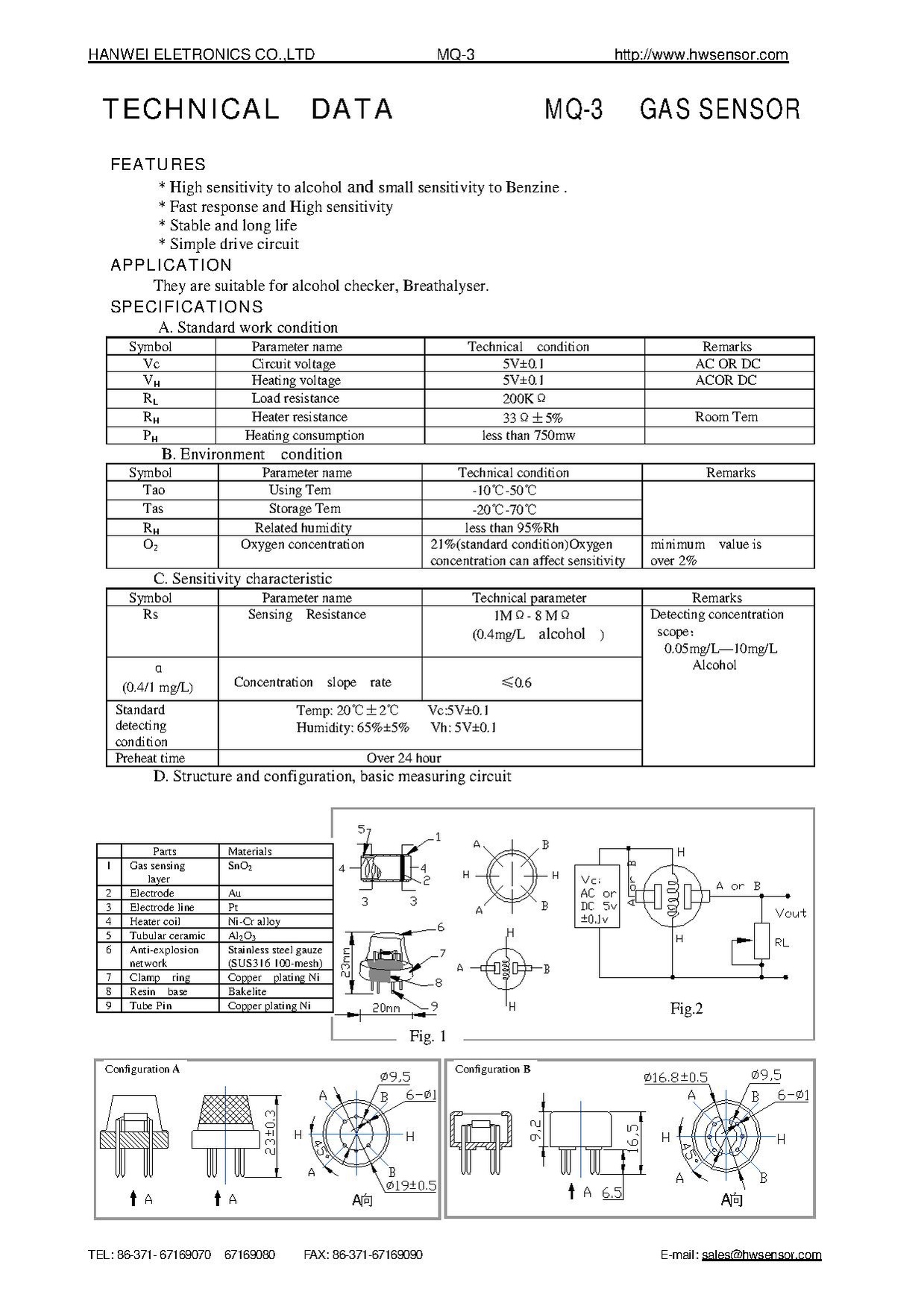
Source: Hanwei Electronics Co., Ltd., "MQ-3 Gas Sensor Technical Data", available at: http://www.hwsensor.com

